
As the calendar pages turn towards 2026, the question for every ambitious small business owner and law firm partner isn’t just about what you’ll achieve, but how you’ll fund those achievements. The answer lies in a powerful, proactive financial strategy: budgeting for profit. This isn’t merely about tracking expenses; it’s about architecting a roadmap to financial success.
It’s the very essence of our mission at RPPC Inc.: “Realizing Profitable Potential through Change.” By moving beyond simple expense management and embracing a forward-looking approach, you can transform your budget from a restrictive document into a dynamic tool for growth. Effective budgeting for profit is the cornerstone of sustainable success, providing the clarity and control needed to navigate the year ahead with confidence.
This guide will walk you through five critical steps to build a robust financial plan for 2026, ensuring you’re not just surviving, but thriving.
Table of Contents

Step 1: Analyze 2025 Performance – The Foundational Look Back
Before you can chart a course forward, you must understand precisely where you stand. A successful strategy for budgeting for profit always begins with a thorough, honest review of your 2025 financial performance. This isn’t an exercise in self-criticism; it’s a data-gathering mission to identify strengths, weaknesses, and opportunities.
The Good, The Bad, and The Fixable
To begin, gather your three core financial statements for the past 12 months:
- Profit & Loss (P&L) Statement: This shows your revenues and expenses over the year. Where did you make the most money? Which expenses were higher than anticipated? Were your profit margins consistent?
- Balance Sheet: This provides a snapshot of your assets, liabilities, and equity at a specific point in time. How has your company’s net worth changed? Are you carrying too much debt?
- Cash Flow Statement: This tracks the movement of cash into and out of your business. Did you experience any cash crunches? Is your cash flow positive and predictable?
Organize your findings into three categories: “The Good” (high-margin services, successful marketing campaigns), “The Bad” (unprofitable ventures, unexpected cost overruns), and “The Fixable” (inefficient processes, subscription services you no longer need). This analysis provides the raw data needed for intelligent budgeting for profit. It’s about learning from the past to build a more profitable future.
Having immaculate financial records is non-negotiable for this step. If your books are a mess, this analysis becomes nearly impossible. This is where foundational support from our expert bookkeeping services can be a game-changer, providing the clean, accurate data you need to make informed decisions and truly master the art of budgeting for profit.
Step 2: Choose Your Budgeting Method – The Strategic Framework
Not all budgets are created equal. The method you choose will significantly impact how you plan and operate. For small businesses and law firms, selecting the right framework is a critical part of budgeting for profit. Let’s explore three common approaches.
Zero-Based Budgeting (ZBB)
With ZBB, you start from zero each budgeting period. Every single expense must be justified for the new period. It forces you to scrutinize every dollar, which is excellent for cutting waste and optimizing spending.
- Pros: Highly effective for cost control, promotes efficiency, and forces a deep analysis of operations.
- Cons: Time-consuming and can be complex to implement.
For a business looking to make significant changes, ZBB is a powerful tool for budgeting for profit because it challenges the status quo.
Incremental Budgeting
This is the most common method. You take the previous year’s budget and make incremental adjustments (e.g., a 5% increase for marketing, a 3% increase for salaries) based on expected changes.
- Pros: Simple, quick, and stable.
- Cons: Can perpetuate past inefficiencies and doesn’t encourage a critical review of spending.
While easy, this method may not be the most effective for aggressive budgeting for profit and growth.
Value-Proposition Budgeting
This approach aligns every expense with the value it brings to the business. You ask, “Does this expense contribute to our strategic goals and profitability?” It’s a more strategic way of thinking that connects spending directly to outcomes, a core tenet of budgeting for profit.
- Pros: Aligns spending with strategy, encourages investment in high-value activities.
- Cons: Can be subjective and requires a very clear understanding of your business goals.
Choosing the right method, or even a hybrid approach, sets the stage for a successful financial year. It’s about finding the right balance between control and flexibility, a key challenge in effective budgeting for profit.
[Image Placeholder] Alt Tag: A flowchart comparing Zero-Based, Incremental, and Value-Proposition budgeting methods for small businesses. Caption: Selecting the right framework is the first step in building a budget that drives growth in 2026.
Step 3: Build Your 12-Month Operating Budget – The Profit Blueprint
With your historical data analyzed and a method chosen, it’s time to construct the budget itself. This is your financial blueprint for 2026, the tangible expression of your plan for budgeting for profit. Break it down into two main components: revenue forecasting and expense planning.
Forecasting Revenue Realistically
Your revenue forecast is the foundation of your entire budget. Be optimistic, but ground your optimism in data.
- Analyze Historical Data: Look at sales trends from the past 1-3 years. Are there seasonal peaks and valleys?
- Consider Your Sales Pipeline: For B2B businesses and law firms, what does your current pipeline of prospects and signed clients look like?
- Factor in Market Conditions: Are there economic trends that could impact your industry? Are you launching new services or raising prices?
Create a month-by-month revenue projection. This detailed forecast is essential for managing cash flow and making timely decisions. A well-researched revenue forecast is the engine of budgeting for profit.
Master Your Expenses: Fixed vs. Variable
Next, detail your anticipated expenses. Separating them into fixed and variable costs provides immense clarity.
- Fixed Costs: These are expenses that remain the same regardless of your revenue, such as rent, salaries, insurance, and software subscriptions. They are predictable and form the baseline of your budget.
- Variable Costs: These expenses fluctuate with your business activity, such as cost of goods sold (COGS), marketing spend, commissions, and hourly contractor fees. Managing these is key to improving profitability.
Your goal in budgeting for profit is to ensure that your forecasted revenue comfortably covers all fixed and variable costs, leaving a healthy margin for profit. This detailed plan allows you to see where every dollar is going and make strategic cuts or investments. This process is how you begin “Realizing Profitable Potential through Change,” by actively designing your financial future instead of reacting to it. Proper budgeting for profit turns aspirations into a concrete plan.
Step 4: Forecast Cash Flow and Capital Expenditures – The Future View
Profit is a great metric, but cash is the lifeblood of your business. A profitable company can still fail if it runs out of cash. Therefore, a crucial component of budgeting for profit is creating a detailed cash flow forecast. This is distinct from your P&L statement; it tracks the actual cash moving in and out of your bank accounts.
The Critical Difference Between Profit and Cash Flow
Imagine you’re a law firm that completes a large project in January and invoices the client for $50,000. On your P&L, you’ve earned that profit in January. However, if the client is on a 90-day payment term, you won’t see that cash until April. In the meantime, you still have to pay salaries, rent, and other bills in February and March. This is the cash flow gap. A cash flow forecast helps you anticipate these gaps and plan for them, according to the Small Business Administration, which emphasizes its importance for stability.
Your forecast should map out monthly cash inflows (revenue collections, loans) and outflows (payroll, rent, inventory purchases, loan payments). This proactive view is a non-negotiable part of budgeting for profit and preventing liquidity crises.
Planning for Big Investments (CapEx)
Capital Expenditures (CapEx) are significant purchases of physical assets, such as new computers, office furniture, machinery, or a company vehicle. These are not regular operating expenses. They are long-term investments. Your annual budgeting for profit process must include a plan for any major CapEx you anticipate in 2026. Will you pay with cash, or will you need financing? Planning for these large outflows prevents them from derailing your cash flow and ensures you can invest in the assets needed for growth without jeopardizing financial stability. This forward-thinking is what budgeting for profit is all about.
[Image Placeholder] Alt Tag: A simple line graph illustrating a positive 12-month cash flow forecast for a small business, showing inflows vs. outflows. Caption: Proactive cash flow forecasting ensures your business has the fuel it needs to operate and grow throughout the year.
Step 5: Define and Track KPIs – Your Financial Scorecard
Your budget is not a “set it and forget it” document. It’s a living plan that needs to be monitored. Key Performance Indicators (KPIs) are the metrics you use to track your progress against the goals set in your budget. This is the final, crucial step in budgeting for profit—turning your plan into measurable results.
Key KPIs for Small Businesses and Law Firms
While every business is unique, some KPIs are universally important:
- Gross Profit Margin: (Revenue – Cost of Goods Sold) / Revenue. This tells you how profitable your core products or services are.
- Net Profit Margin: Net Income / Revenue. This is the ultimate measure of profitability after all expenses, including overhead, are accounted for.
- Customer Acquisition Cost (CAC): Total Sales & Marketing Costs / Number of New Customers Acquired. Are you spending efficiently to attract new business?
- Client Lifetime Value (CLV): The total revenue you can expect from a single client account. A healthy business model has a CLV significantly higher than its CAC.
- Days Sales Outstanding (DSO): The average number of days it takes to collect payment after a sale has been made. A high DSO can signal cash flow problems.
Integrating these KPIs into your monthly financial review process allows you to see if your budgeting for profit strategy is working. Are you hitting your revenue targets? Are expenses staying in line? If not, you can make course corrections quickly, rather than waiting until the end of the year. This active management is where our Controller and CFO Services provide immense value, helping you interpret these numbers and make high-level strategic decisions. True budgeting for profit requires constant vigilance and adjustment.
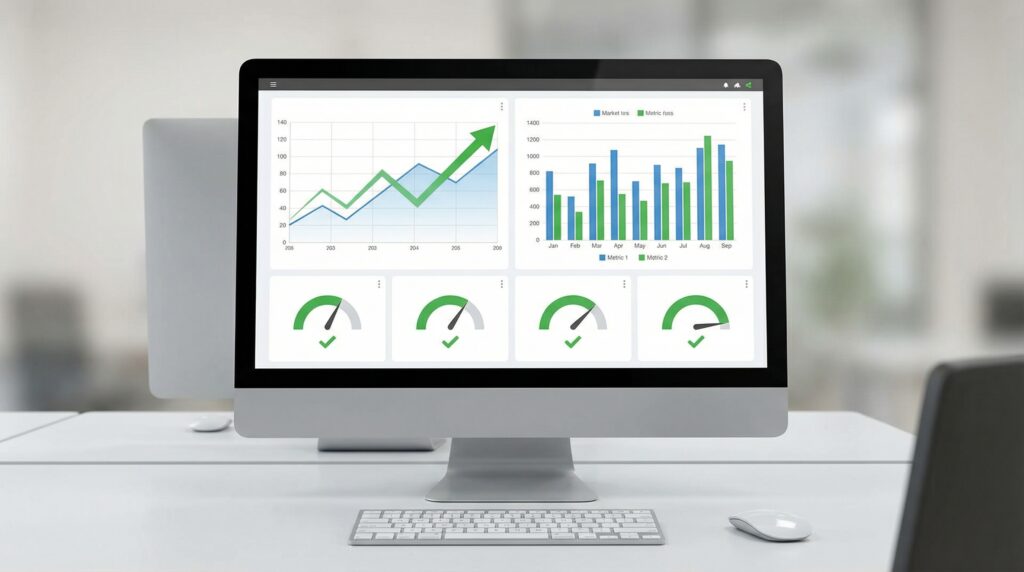
[Image Placeholder] Alt Tag: A modern dashboard graphic displaying KPIs for effective budgeting for profit, including Gross Profit Margin and Net Profit Margin charts. Caption: Tracking the right KPIs turns your budget into a dynamic tool for measuring and improving performance.
A Special Note for Law Firms: Trust Financial Management and Budgeting
For our clients in the legal field, budgeting for profit has an added layer of complexity and responsibility: IOLTA and trust financial management. Client funds held in trust are not your firm’s money and must never be co-mingled with your operating account. Failure to comply can have severe consequences, including disbarment. According to the American Bar Association, strict rules govern these accounts.
Your operating budget must be robust enough to ensure you never have to dip into client funds to cover firm expenses. This means meticulous cash flow forecasting is even more critical. Your budgeting for profit process must clearly delineate between firm revenue and client funds, ensuring compliance and protecting your practice. At RPPC Inc., we specialize in legal trust financial management, helping firms maintain pristine records and build budgets that ensure both profitability and ethical compliance. This specialized focus is a key part of our approach to budgeting for profit for law firms.
Conclusion: From Budgeting to Profitable Potential
Moving into 2026, your budget should be your most powerful strategic tool. By following these five steps—analyzing the past, choosing the right framework, building a detailed blueprint, forecasting cash flow, and tracking KPIs—you transform budgeting from a chore into a proactive strategy. You stop budgeting for survival and start budgeting for profit.
This is the heart of “Realizing Profitable Potential through Change.” It’s about taking control of your financial narrative and making deliberate choices that lead to growth, stability, and success. The process of budgeting for profit may seem daunting, but the clarity and confidence it provides are invaluable.
If you’re ready to build a financial foundation that will make 2026 your most profitable year yet, we’re here to help. The team at RPPC Inc. has the expertise to guide you through every step of the budgeting for profit process. Contact us today for a consultation and let’s unlock your business’s true potential together.
Frequently Asked Questions (FAQ)
What is the biggest mistake businesses make when budgeting for profit?
The most common mistake is creating a budget and then ignoring it. An effective budget is a living document. It should be reviewed monthly against your actual performance. This allows you to make timely adjustments, capitalize on opportunities, and mitigate risks before they become major problems. Another mistake is being overly optimistic with revenue forecasts without data to back them up, which can lead to a cascade of financial issues. Successful budgeting for profit requires realism and regular engagement.
How often should I review my business budget?
For most small businesses and law firms, a monthly review is ideal. This frequency allows you to compare your budgeted projections to your actual financial results (a process called variance analysis). It helps you stay on track, understand why you are over or under budget in certain areas, and make agile decisions. An annual plan with monthly check-ins is the best practice for effective budgeting for profit.
Can QuickBooks help with budgeting for profit?
Absolutely. QuickBooks is an excellent tool for this purpose. It allows you to create budgets based on historical data, run reports that compare your budget vs. actuals, and get a clear view of your financial health. However, the tool is only as good as the data within it and the strategy behind it. Our QuickBooks consulting services help businesses set up their systems correctly to leverage these features for powerful budgeting for profit and financial analysis.
Is zero-based budgeting too difficult for a small business?
While it is more time-intensive than incremental budgeting, it’s not necessarily too difficult and can be incredibly valuable. A small business could decide to do a full zero-based budget every 2-3 years to do a “deep clean” of its expenses, while using a less intensive method in the intervening years. The key is finding a sustainable process that forces you to think critically about your spending, which is the ultimate goal of budgeting for profit.As the calendar pages turn towards 2026, the question for every ambitious small business owner and law firm partner isn’t just about what you’ll achieve, but how you’ll fund those achievements.